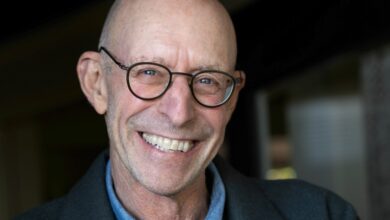
An interview with author Saro Varjabedian

Saro Varjabedian is a New York-based cinematographer, filmmaker and writer whose work has screened at festivals around the world. His films — including “Right to Privacy,” “Driving the Green Book” and “Runner” — blend emotionally powerful storytelling with thought-provoking themes, engaging viewers while encouraging introspection. Varjabedian is now also an adjunct assistant professor in the Film MFA program at Columbia University, his alma mater.
His debut book, “Tim and Robot: A Spiritual Agnostic’s Guidance To A Newly Formed Consciousness” published this fall, invites readers to ask questions and re-evaluate how they approach life.
We caught up with Varjabedian following the release of “Tim and Robot” to talk about his agnosticism, his evocative films and his hopes for the next generation of storytellers.
This interview has been edited for length and clarity.
Rosie Nisanyan (R.N.): Your book, “Tim and Robot: A Spiritual Agnostic’s Guidance To A Newly Formed Consciousness,” just came out – congratulations! What motivated you to write it? Was it inspired by your podcast, “Coffee, Matcha and Soul?“
Saro Varjabedian (S.V.): Yeah, partly. Actually, a lot of my recent work has been inspired by politics. The driving force was Roe v. Wade and its overturning in 2022. That was such a disheartening moment for me. I don’t think we can discount the significance of that moment because it’s only the second time in our country’s history where the Supreme Court has taken a right away. In general, over the arc of our country’s history, the Supreme Court has been about ruling in ways that gave more people more rights and more freedoms.
What’s disheartening to me about it is that they claim their decision was based on the thought that our forefathers didn’t account for this right, so we shouldn’t have it. But I think what’s not being said is that our conservative judges, who are Christian fundamentalists, believe, based on their religion, that God says that abortion shouldn’t be done. Although that was also never said in the Bible, somehow, that’s been extrapolated. They are making judgment calls on the laws of our country based on their beliefs.
I’ve been pretty devoutly agnostic for most of my life — and we could talk about what it means as an Armenian when Christianity is so important for us. What I wanted to do was share my viewpoint as an agnostic, just to open people’s minds to thinking about these complex issues in ways grounded more in logic and reason, as opposed to feelings, assumptions and old beliefs.
Around that time [of Roe v. Wade being overturned], I started focusing my creative pursuits on what I could do as a citizen, beyond just voting. What could I do as a creative to help in these conversations? That’s when I started producing short films like “Right to Privacy,” “Driving the Green Book” and “Runner.”
At the same time, I started writing a book on agnosticism and then, about a year and a half ago, I got the idea for “Tim and Robot.” The idea was this:
How do we look outside of ourselves as humans and question our assumptions? And what better vehicle than a non-human being that comes alive — a robot that becomes aware — that then has questions for its creator?
And the creator — the scientist, Tim — is basically me trying to answer these questions.
I don’t have children, but the wonderful thing about them is that they’re so curious about the world and they still have questions. We start to lose that as adults because we come to assume that this is how things are. Nothing has to be the way it is. A lot of it is because of our conventions, but you can re-look at things and say, “Wait, is this really working? I know that’s how we’ve been doing it, but should we continue doing it this way?” And so Tim, or myself, tries his best to answer the robot’s questions.
I wanted it to be fun and playful. The original book I was writing on agnosticism was not that. It was dry, almost like lecture-style writing, so I wanted this to be playful and fun to engage all audiences.

“Coffee, Matcha and Soul,” came about because my two close friends and co-hosts, Zair Montes and Guillermo Iván, share the same desire to create meaningful, entertaining and uplifting content. The goal for the show is to create a platform where we can have deep, difficult conversations in a safe space to learn from people’s lived experiences.
R.N.: Since you brought it up, what does it mean to you to be Armenian and agnostic?
S.V.: I do love the key values of Christianity. I love the story of Jesus Christ in that he just really wanted to offer people a way of being that can uplift everyone, right? The tenet of “Do unto others as you would have them do unto you” — it’s very simple and it still works today, and it will work 10,000 years from now, so that needs to be held on to and passed on.
What I could do without are some of the mystical aspects. Like, I don’t need Jesus to have been resurrected. I don’t need Jesus to have created wine out of water and to walk on water. I don’t need the magic, necessarily. Actually, to me, it’s way more powerful to imagine Jesus was just a regular person who had this idea on how he can make life better for other people, and he was willing to die to do that. That makes it way more powerful than if he was somehow connected to God, would be resurrected and knew he would just be returning to God. Without that, he would have been putting more at stake when he was trying to spread his message.
But I don’t think we need to throw it all out. As part of finding happiness, I think going to church, investing your time in something meditative, where you talk about morality, is great. I think the problem then becomes when some of these principles no longer make sense today because we have more knowledge, more information and can think about things in a different way. Technology is changing things very quickly, so you have to adjust.
Something I do talk about in the book is perhaps the morality of getting married and not having sex outside of marriage. You can imagine that 2,000-3,000 years ago, there was no such thing as contraceptives or abortion, so engaging in sex meant you’re probably going to have a child. And then, what do you do? You create family structures in order to support that child. It comes out of logic, then; it’s not as logical now because we have contraception. Growing up as a Christian, I also had some feelings about sex and morality, but after a while, we have to reassess.
I understand that tradition is important. If I have any fault with religion, I think you do have to evolve with the times, and if you’re not evolving, I think that’s a problem. And no, we can’t just stick our heads in the sand — that’s not going to work either.
As an Armenian, religion is so fundamentally important to us: we were the first nation to accept Christianity and we fought many wars to protect our religion. Because we’re such a Christian nation, that does affect our culture; it’s ingrained in it. That’s the hardest part for me because I’m proud to be Armenian, but as an agnostic, I have a hard time saying I’m Christian.
R.N.: I think one of the challenges of being Armenian is that so much of the community is based out of the church — cooking classes, dance classes, fellowship, etc. If you’re not there, you can miss out on more than just the religion aspect.
S.V.: Absolutely, that’s a great point. The church acts as a center point for Armenians to get together. I had a really good friend who was an archaeologist and had very clear ideas about how we came to be as humans, but she was involved in the church and would go to all the events — not necessarily the church service, but she loved the community.
R.N.: Something that really resonated with me in the book is when Tim tells Robot, “Perhaps over time, you may come to develop your own sense of joy or happiness in the things you experience.” I think this is especially important for young people, because with FOMO [fear of missing out] and “viral trends,” it’s easy to get caught up in trying to enjoy what everyone else seems to enjoy. But that won’t necessarily make you happy. You have to find the things that you specifically enjoy, not what you think you need to enjoy. Was any of that in your mind as you wrote it?
S.V.: Honestly, it’s really written for the next generation. That was my intent. Part of it is also that I’m 46 now and what I see happening to my friends and elders is that they’re not open to changing their view of the world. They get fixed and stuck, and they tend to get fixed and stuck in old ideals of what the world used to be.
I have a lot of hope for the next generation. I want them to do better. We should all want the next generation to do better than us.
I talk about that in “Tim and Robot.”
In terms of figuring out what makes you happy, one part is understanding ourselves. We have to understand what drives us and why we do the things we do. If we don’t understand why we do certain things, then we’re just kind of acting like robots and going along with a program. You have to really ask, “Why do I like this?” or “Why does this make me happy?”
For me, it doesn’t take much — the things that make me happy are green tea and matcha and sunsets. But that all comes from a real appreciation for being alive and being present in the moment. As I’m experiencing things presently, I get great joy out of that, but that came with time and work. For a younger person experiencing perhaps FOMO, I think that’s also part of growing up. I don’t want to say that you shouldn’t have FOMO; I would say that you should absolutely be excited about experiencing as much of the world as possible, especially when you’re young and you have that energy.
However, the problem of FOMO in relation to social media and, really, commercialism comes down to this: “Oh, you need this to be happy. You need that to be happy. This is the next thing that’s going to make you happy.” Commercialism works by selling you an idea that will get you to spend money on these products because they’re supposed to bring you happiness in some way. What I’ve found is that these things don’t bring you genuine happiness. FOMO could become a problem when your happiness is completely tied to that next thing, right? You’re not happy when you don’t have it, so then you’re seeking to get that thing, and then you get that thing and you’re happy for a little while, but then you’re no longer happy because of that next thing. Happiness has to come from within. That’s the key.
Ultimately, part of it is having grace for yourself and appreciating yourself. The other part is to find the things that genuinely fulfill you through purpose and meaning. And that could be anything, as long as it’s constructive. Whether that’s meditation, yoga, rock climbing, music — whatever it is you have a passion for, do it.
R.N.: You’re also an accomplished cinematographer – three of your short films were part of the ARPA International Film Festival last year: “Runner,” “Driving the Green Book” and “Right to Privacy.” And “Driving the Green Book” won Best Documentary. How did it feel to have your work showcased there?
S.V.: It was a pleasure and honor! I’ve been to ARPA several times over the years: I had my first film there in 2009 and my second in 2013 — that one was my thesis film, “After Water There Is Sand;” and then, my feature film, “Respite,” played there in 2020. It’s always wonderful to go back there when I can.
ARPA has been an incredibly supportive community. I know that my films weren’t Armenian-themed, but ARPA is an international film festival, so it’s not necessarily Armenian, but they obviously cater to Armenian filmmakers and writers and they support Armenians in film. “Driving the Green Book” won Best Short Documentary at the festival and that was amazing.

R.N.: “Driving the Green Book” is essentially a road trip across Long Island, featuring places that were once listed in “The Negro Motorist Green Book.” Can you tell me more about the short film and what it was like for you, being from the area?
S.V.: The Green Book was created by Victor and Alma Green and was published from 1936 to 1964. Before ‘64, as Black Americans would travel from North to South or South to North, there were many places they weren’t allowed to use, like restaurants, gas stations. So, how do you travel, right? As Victor and Alma Green were traveling, they took it upon themselves to document places that would allow Black Americans to use their services. They basically created a travel guide for Black Americans, listing all the places that would allow them in.
On how the film came about, my good friend Alvin Hall had done a podcast in 2020 of the same name, “Driving the Green Book,” where he and his producer and crew started in Detroit and drove down to New Orleans, stopping in cities along the way and using the Green Book as a guide. He would talk to people in the community, people who used the Green Book and historians to understand its significance and how people were using it and for what purpose. It was amazing work, if you think about it.
We, along with producer/director Mike De Caro, had gotten a grant from Film Independent, so we had a small sum of money and were wondering what we could do with it. We were trying to get a TV series made; that was really the goal. As a teenager in New York in the early ‘90s, that racism was still alive and well. I saw it. I had friends who were Black and whenever we would drive together, we would get pulled over, but when I would drive alone, I was fine. So, this isn’t that far back in our history. We think of New York as this very progressive town, and maybe the city is, but just a little outside, it’s less so. We knew that there would be a story to tell in Long Island, so we got a copy of the Green Book and found places in Long Island that were once listed as safe spaces for Black Americans. We found a historian and a lawyer who could speak to us. Even today, Long Island’s quite segregated, but back in those days, there were genuine sundown towns where a Black American couldn’t be caught after 6 p.m. That’s why we chose Long Island; there was definitely a history and story to be told there.
R.N.: Do you have any advice for aspiring Armenian filmmakers or authors?
S.V.: My advice would be: just keep doing it. You have to do it. You have to create it. If you wait, it’s not going to come. Find a way to do what you can to be an artist, to be a creative — whether that’s writing or doing a short film and submitting to festivals. Do what you can to keep working on your craft and do it because you love it. If you love it, then you’re not working.
Saro Varjabedian’s book “Tim and Robot: A Spiritual Agnostic’s Guidance To A Newly Formed Consciousness” is now available for purchase at select retailers and as an e-book. You can follow him on Instagram @SaroVarjabedian and stream his podcast “Coffee, Matcha and Soul” on Spotify.
All photos are courtesy of Saro Varjabedian unless otherwise noted.